
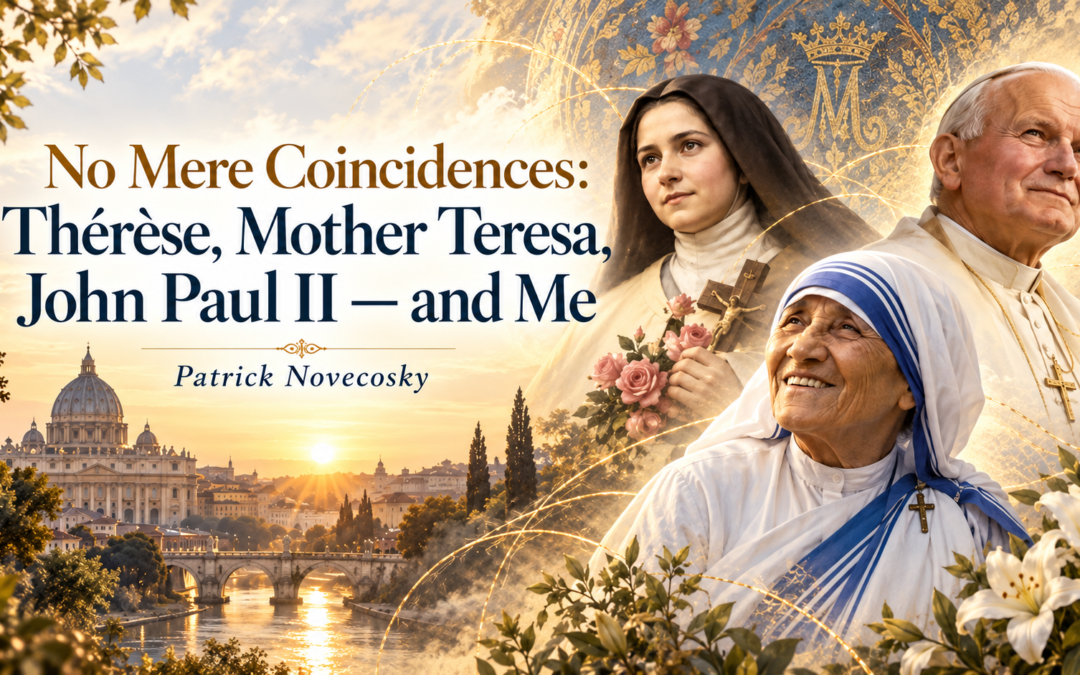
It’s October 1, the feast of St. Thérèse of Lisieux, and the shipment was something I’d been waiting years to see.
Inside were my author copies of Icons of Mercy: The Faith, Friendship, and Legacy of John Paul II and Mother Teresa.
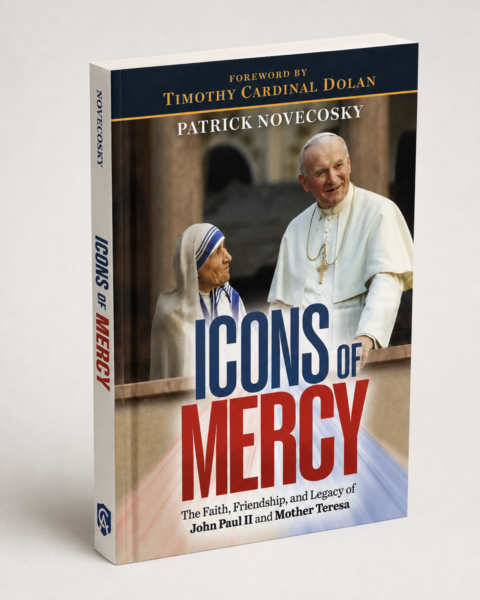 I smiled when I realized today’s significance.
After all, as Pope St. John Paul II once said, “In the designs of Providence, there are no mere coincidences.”
We rarely recognize God’s designs as they unfold. Most of the time, we are simply too close.
It can be like standing inches from a great painting. All we see are individual brushstrokes, odd patches of color, and seemingly disconnected lines. Or perhaps it is more like looking at the back of a tapestry, where the threads appear tangled and chaotic, with little indication of the beautiful image being formed on the other side.
Only with time and distance do some things begin to come into focus. Looking back, we may occasionally glimpse God’s fingerprints and begin to understand a little of what he was doing all along.
The full picture, of course, remains hidden from us. Only in heaven, if by God’s grace we are blessed to enter, will we fully see how all the threads were woven together.
I have thought about that often when recalling something that happened to me nearly three decades ago.
Twenty-nine years earlier, on October 1, 1997, I met John Paul II for the first time. And St. Thérèse—the Little Flower—had something to do with that, too.
I was 29 years old and working for the Marian Fathers of the Immaculate Conception in Stockbridge, Massachusetts, as associate editor of Marian Helper magazine. The unlikely chain of events that eventually put me inside the papal apartments began with a raffle ticket.
Every year, vendors who worked with the Marians donated prizes for an employee raffle, with the proceeds going to charity. In the fall of 1996, the grand prize was a trip for two to Cancun.
I won.
There was just one problem: I had little interest in going to Cancun. I wanted to go to Rome.
The travel agency graciously allowed me to exchange the prize, and soon a much more ambitious trip began taking shape. After the fall of communism, John Paul II asked the Marians to lead Eastern Europe’s re-evangelization. Many Marian priests had lived and ministered behind the Iron Curtain. My assignment was to travel through the region, interview them, and tell their stories.
Rome would be my first stop.
The Marians knew John Paul II well. Their superior general had been a student of the future pope at the Catholic University of Lublin, and priests and brothers from the community regularly visited the Holy Father.
When my boss asked whether I would like to stay at the Marian house in Rome and perhaps meet the pope, my answer was immediate.
“Yes, please.”
John Paul celebrated Mass each morning in his private chapel. Bishops visiting Rome sometimes concelebrated, and when seats were available, a small number of laypeople could be invited. The call usually came from the office of Monsignor Stanisław Dziwisz, the pope’s longtime private secretary, the evening before.
My brother Fred joined me on the trip, and every evening we returned to the Marian house with the same question for the little Italian nun who answered the telephone.
“Was there a call from the Vatican?”
“No, signori. No call.”
The Little Flower Opens a Door
As the days passed, I began asking St. Thérèse of Lisieux to intercede for me. My reasoning was simple: Thérèse herself had gone to Rome as a teenager and, during an audience with Pope Leo XIII in 1887, boldly asked him to allow her to enter Carmel at the age of 15.
If the Little Flower had managed an audience with a pope, perhaps she could help me from heaven do the same.
On our fourth afternoon in Rome, Fred and I wandered into the Archbasilica of St. John Lateran. Television cameras had been set up, and images of Thérèse seemed to be everywhere. I couldn’t read the Italian signs and didn’t understand why there was so much attention being given to her.
But seeing her image reminded me once again to ask for her intercession.
I whispered a prayer.
Then we went home.
This time the little nun came looking for us.
“Signori,” she said. “They called. You will see the Holy Father tomorrow.”
The next morning was October 1—the feast of St. Thérèse of Lisieux.
Only later did I discover something else: the prayer I whispered at St. John Lateran had been answered on September 30, 1997—exactly 100 years to the day after Thérèse died in the Carmel of Lisieux.
Suddenly all those posters made sense.
The next morning, a member of the papal staff escorted Fred and me through the Apostolic Palace to the pope’s private chapel. As I rounded the corner, I caught my first glimpse of John Paul II.
He was kneeling before the Tabernacle, deep in prayer.
My heart literally leaped in my chest! I remember thinking that he seemed to glow.

Patrick Novecosky meets with Pope John Paul II on Oct. 1, 1997
After Mass, we were ushered into an adjoining room to meet him. Monsignor Dziwisz introduced me to the pope as being with the “Padri Mariani”—the Marian Fathers. I presented the pope with pages from the Marians’ recently launched website, bound in a hand-tooled white leather folder. I had been working on material explaining John Paul’s efforts to advance the cause of Sister Faustina Kowalska and promote the message of Divine Mercy.
The Holy Father thanked me and placed a rosary in my hand.
That encounter began a remarkable five-year period during which I met John Paul II five times. My final encounter came in 2002, just 11 days after my wedding, when my wife and I were presented to him as newlyweds in St. Peter’s Square.
A Thread I Couldn’t Yet See
But the Thérèse connection did not end in 1997.
Years later, as I began researching the friendship between John Paul II and Mother Teresa for Icons of Mercy, I came to appreciate another beautiful thread running through the story.
Mother Teresa was, in a very real sense, a daughter of the Little Flower.
Born Gonxha Agnes Bojaxhiu in 1910, she began feeling the call to religious life and the missions while still a girl. As a teenager, she dreamed of going to India as a missionary.
In 1925, when Gonxha was 15, Pope Pius XI canonized Thérèse of Lisieux. Two years later, he named the cloistered Carmelite—who had never set foot in a mission territory—co-patroness of the missions.
When Gonxha entered the Sisters of Loreto, she chose Thérèse as her patron and took Sister Mary Teresa as her religious name. Because another sister already bore the name Thérèse, she used the Spanish spelling, Teresa.
Mother Teresa was not named for the great Spanish Carmelite reformer St. Teresa of Ávila. She was named for the “little” Thérèse of Lisieux, the young nun whose hidden life of prayer and sacrifice helped inspire a woman who would become one of the greatest missionaries of the 20th century.
And then there is one more remarkable connection.
Mother Teresa died on September 5, 1997.
Just weeks later, on October 19—World Mission Sunday—John Paul II proclaimed Thérèse of Lisieux a Doctor of the Church. He called her “a model of missionary commitment and the patroness of the missions,” even though she spent her religious life behind the walls of a Carmelite convent.
Between Mother Teresa’s death and Thérèse’s proclamation as a Doctor of the Church came my own tiny encounter with this much larger story.
On September 30, the centenary of Thérèse’s death, I asked for her help.
On October 1, her feast day, I met John Paul II.
Twenty-nine years later, on October 1, 2026, another package arrived at my door.
This one contained the first copies of a book about John Paul II and Mother Teresa—the pope who declared Thérèse a Doctor of the Church and the missionary who had taken Thérèse as her patron.
Seeing the Pattern in Providence
When these events happened individually, I could not possibly have known where they were leading.
In 1997, I could not see that meeting John Paul II would become such an important part of my life, that I would eventually write two books about him, or that nearly three decades later I would write about his extraordinary friendship with Mother Teresa.
Nor could I have imagined that the Little Flower, whose intercession I sought almost casually while wandering through St. John Lateran, would emerge years later as a quiet thread connecting the two saints at the center of my book.
Perhaps that is often how Providence works.
We live our lives one brushstroke at a time. We see the loose threads on the back of the tapestry. Occasionally, God allows us enough distance to recognize part of the picture—and perhaps to glimpse His fingerprints upon it.
But we should be humble about what we think we see. We know only a fragment of the story.
Someday, God willing, the tapestry will be turned around.
Then we will see the whole picture.
Until then, I keep returning to the words of the saint I first met on the Little Flower’s feast day:
“In the designs of Providence, there are no mere coincidences.”
Merci, Thérèse!
Dziękuję, John Paul!
Thank you, Mother Teresa!